To re-cap, my tiered cake will have a 12-inch base tier made from chocolate cake, with a sweet and tart cherry filling and kirsch buttercream. The upper two tiers will be vanilla cake with the same filling and frosting. As with all of the prior posts in this series,
the recipes are working copies, and should not be relied upon. The final post will include the exact recipes. With a 5-quart mixer, you’ll be able to make the batter for the two upper tiers in one batch, but it will also help if you have two ovens or one convection oven, otherwise you would have to move the cakes halfway through baking, and this is not recommended.
Yellow Cake for 9 and 6-inch Tiers4 cups all-purpose flour, measured by fluffing, scooping and leveling
1-1/2 tablespoons baking powder
3/4 teaspoon salt
3 sticks (12 ounces) unsalted butter
3 cups sugar
1 tablespoon vanilla
6 large eggs
1-1/2 cups whole milk
Preheat the ovens to 350 degrees Fahrenheit (325 convection) with a rack in the middle of the oven or upper and lower thirds if using convection. Spray-grease two 9x2-inch round cake pans and two 6x2-inch round cake pans. Line the bottom of the pans with parchment paper, spray-grease the entire pan, and then flour all of the pans.
While the ovens are pre-heating, bring the butter to room temperature, by cutting it into tablespoon-size lumps. Measure out the milk and let it warm up to room temperature. About 5 minutes before starting the recipe, place the eggs (in the shell) into a bowl of warm water to bring them to room temperature.
Sift together the flour, baking powder and salt.
Place the butter and sugar into a large mixer bowl, and beat for a full 5-7 minutes until fluffy. Beat in the vanilla and then the eggs, one at a time, adding them as each is incorporated into the batter. Scrape down the bowl and then beat for a minute to blend everything.
The tricky part comes when you have to add the milk and the flour, alternately into the batter. You start with about 1/4 of the flour, and beat it into the batter on low. Then, by tablespoonful, you want to beat in about 1/3 of the milk. If you add the milk too fast, or it’s not at the right temperature, the batter “breaks”, meaning that it starts to look curdled. Usually, when you add more flour, the batter smoothes out . Continue alternating until all of the milk and the last bit of flour has been incorporated. If the batter is curdled at this point, your final cake is going to be greasy. That’s why it’s so important that the ingredients be at the proper temperature. And make sure that you add the milk slowly, beating in a tablespoon at a time until well mixed before adding more milk.
Divide the batter evenly among all of the pans (I do this by weight, but you can stick a skewer into the batter and make sure that each pan has the same depth).

You can see that I've used magic cake strips on the sides of the pans to help the cakes rise evenly without mounding in the center. The strips get dipped in cold water, squeezed and then wrapped around the pans. Mine are secured with Velcro.
I wish I had seen this set on Amazon before I baked the chocolate layers - maybe they wouldn't have mounded as much. My strips were too small for the 12-inch pans.
Place the pans in the oven and bake the larger pans for 30-40 minutes and the smaller pans for 20-30 minutes, until a tester inserted into the middle of the cakes comes out clean.
Problems:
#1 I can see that I really needed more batter. My tiers need to be all the same height, and this layer will not be a scant 1-1/2-inches – especially if it’s not perfectly flat and needs trimming. I’m going to have to remake the cakes using 7 eggs, instead of 6.

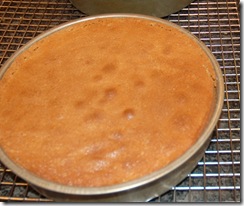
Since I’m not going to be using this layer, I thought I would cut it to see how it tastes, etc. While it tested done – no crumbs stuck to the skewer, I noticed that it wasn’t quite springy to the touch. As I suspected it really could have been cooked a little bit longer. On the next batch I’ll try to cook it until just springy.
Problem #2 - This cake was baked in my lower oven, but it came out much browner than the one baked in my top oven. Because it was browning so much faster, I had to cut back on the temperature midway through baking. I think it will be fine, and the top browned crust will get cut off anyway.
Assembling the layers: I froze the top layer to make it easier to handle, and it was a good thing that I did. Unfortunately, I didn’t notice until I had assembled the tier with frosting and cherries, that the top layer had a deep gouge in it. Because the top layer was partially frozen, I was able to lift it off with a super-sized spatula.

The only problem in doing this, was that Iwasn’t able to get the cherries sufficiently tucked off of the edge of the cake. I then had to go back and poke all of the cherries inward and apply some frosting to the indentation so that they won’t be peeking through the outside frosting. It worked out fine, thankfully, and the remaining two tiers were made and frozen.

Here are the challenges that will face me when I defrost the tiers:
Will the cakes “weep” when they get defrosted, leaving some water on the tops of the cakes, and if so, how will I get it off without marring the surface?
I’ll need to apply the final buttercream trim after the tiers are in place, or I’ll probably damage the trim. Since I don’t want to be messing with buttercream just before the party starts, I’ll have to put together two of the tiers either earlier that day, or the day before. Since I’ve made the supports slightly higher than the cake so that the frosting won’t get smooshed, will I be able to move the cake to the refrigerator and then back to the table on which it will sit? Or should I shorten the supports after the cake defrosts and not worry about the frosting?
Next job will be to make some sugarpaste flowers…