Friday, November 13, 2009

Apple Cherry Turnovers

apple turnovers 002a


Turnovers are a really nice pastry to take to a party . They’re elegant and pretty and just the right size, when made as 3-1/2-inch pickups. Although not difficult to make, they require a little advance planning, as the filling needs to be cooked ahead. Turnovers only bake for about 20 minutes, and this isn’t enough time to cook most fruits. In addition, when fruit cooks, it gives off liquid – sometimes quite a lot of liquid, and this would make the turnover soggy. The last reason for cooking the filling ahead is that cooked filling adheres to itself and stays in a cohesive mass, making it much easier to work with.

If you read my blog on Apple Pie (http://amazingdessertrecipes.blogspot.com/2009/10/best-apple-pie.html) you know that I cooked up all different kinds of apples to see how much liquid each gave off. For the apple pie, I wanted something that would have a nice bit of juice that would spill out a bit when the pie was cut. But for turnovers, you want just the opposite. Apples that exude tons of juice, tend to be a bit dry on their own, and since you can’t use the juice in the turnovers, you actually want to use the less juicy apples in the turnover filling.

Here’s a chart of apple types with how juicy they are, how soft they get and how sweet they are:
Apple Texture Juiciness Sweetness
Macintosh------- Very soft-----Least------------Sweet/tart
Rome ----------- Very soft-----Least------------Sweet/tart
Cortland--------- Medium------Least------------Sweet/tart
Empire-----------Medium------Moderate--------Sweet/tart
Golden Delicious-Medium------Most------------Sweet
Macoun----------Medium------Most-------------Sweet/tart
Granny Smith----Med-firm----Moderate--------Tart
Fuji--------------Extra Firm---Moderate--------Sweet/tart
Gala-------------Extra Firm--- Moderate--------Sweet/tart

For turnovers, I like to use mostly Cortlands, 1 Mac thrown in for extra apply flavor and applesauce note, and a Granny Smith for a bit of tartness and texture.

The pan that you use for baking the filling will make a huge difference to the filling, as well. I baked one batch in a metal baking pan and another batch in a glass pan, each covered with foil and baked at 350 degrees F. for 30 minutes.

apple turnovers 020

These were the apples baked in the metal pan. They were more like a very chunky applesauce with some of the apples (the Granny Smiths) still in chunks. I did have to mash on the apples a little to get them to come together in a mass.

These are the apples baked in glass. They were still quite firm and not cohesive. I had to bake them another 30 minutes to get them to the state shown above.


apple turnovers 018


By the way, the reason that the apples baked in the metal pan are so dark, is that I didn’t put any lemon juice or Fruitfresh® in with the apples, and the picture was taken the next day. Turnover filling really isn’t seen, but if it matters to you, then you should add one of the acids to keep the apples light.

Apple Cherry Turnovers
Makes 18 or 19 3-1/2” turnovers


1 batch of sweetened pie crust dough , see http://amazingdessertrecipes.blogspot.com/2009/10/best-apple-pie.html

Turnover Filling
3 Cortland apples
1 Macintosh apple
1 Granny Smith apple
2/3-3/4 cup brown sugar
Pinch nutmeg
½ teaspoon cinnamon
½ cup tart dried cherries

juice from 1 lemon, or 1 tablespoon Fruitfresh mixed in 2 quarts cold water, optional

1 tablespoon unsalted butter, cut into 6 chunks

Milk or egg white wash, for brushing, optional

Powdered sugar for sprinkling

Make the pie crust and wrap and refrigerate it as per the instructions with the crust.

For the filling, peel, core and dice the Cortlands and Mac into large dice, and the Granny Smith into ¼-inch dice. If you want to keep the apples from turning brown, drop them into the acidulated water and then scoop them out and pat dry. Place in an 8x12-inch baking pan (or any similar pan) and stir in the brown sugar, nutmeg, cinnamon, using quantities to taste. Stir in the dried cherries. Scatter the butter over the top. Cover with aluminum foil, and bake for 30-50 minutes , until most of the apples are mushy but the Granny Smith is still in medium-firm chunks. The apples may look like they are still firm, but when pressed with a spoon, they will yield readily. Uncover, and let the mixture cool. Transfer to a storage container, and refrigerate until ready to use.

When ready to prepare the turnovers, preheat the oven to 375-degrees F., with racks in the middle and lower sections of the oven. Line 2 baking sheets with parchment paper.

To roll the dough into a rectangular shape, I like to use this tool:
Dobord -Available at: http://www.cooking.com/

clip_image002

The Dobord has grooves cut into the two sides that allow you to drop the bottom down to 4 different levels for 4 different thicknesses of dough. It's terrific for rolling out cookie dough and larger, rectangular or square shapes. You want the turnover dough to be thin, so set the board to the 1/16th-inch setting. You’ll need a rolling pin long enough to sit on the edges of board, and one without ball bearings.

To make it even easier to roll, you can roll the dough inside of a jumbo ziptop bag, which has been cut open on three sides. Flour the inside of the bag, and then roll one piece of dough into a rectangle about 6-inches wide and 8-inches long ( size isn’t really important). Fold the dough like a letter, and then turn it 80-degrees and roll it again to the same size. Fold it again, and then roll it until the pin sits perfectly flat on both edges of the sides.

Cut the dough into 3-1/2-inch squares. Pick up one square and turn it so that the points are now facing you.

apple turnovers 0020

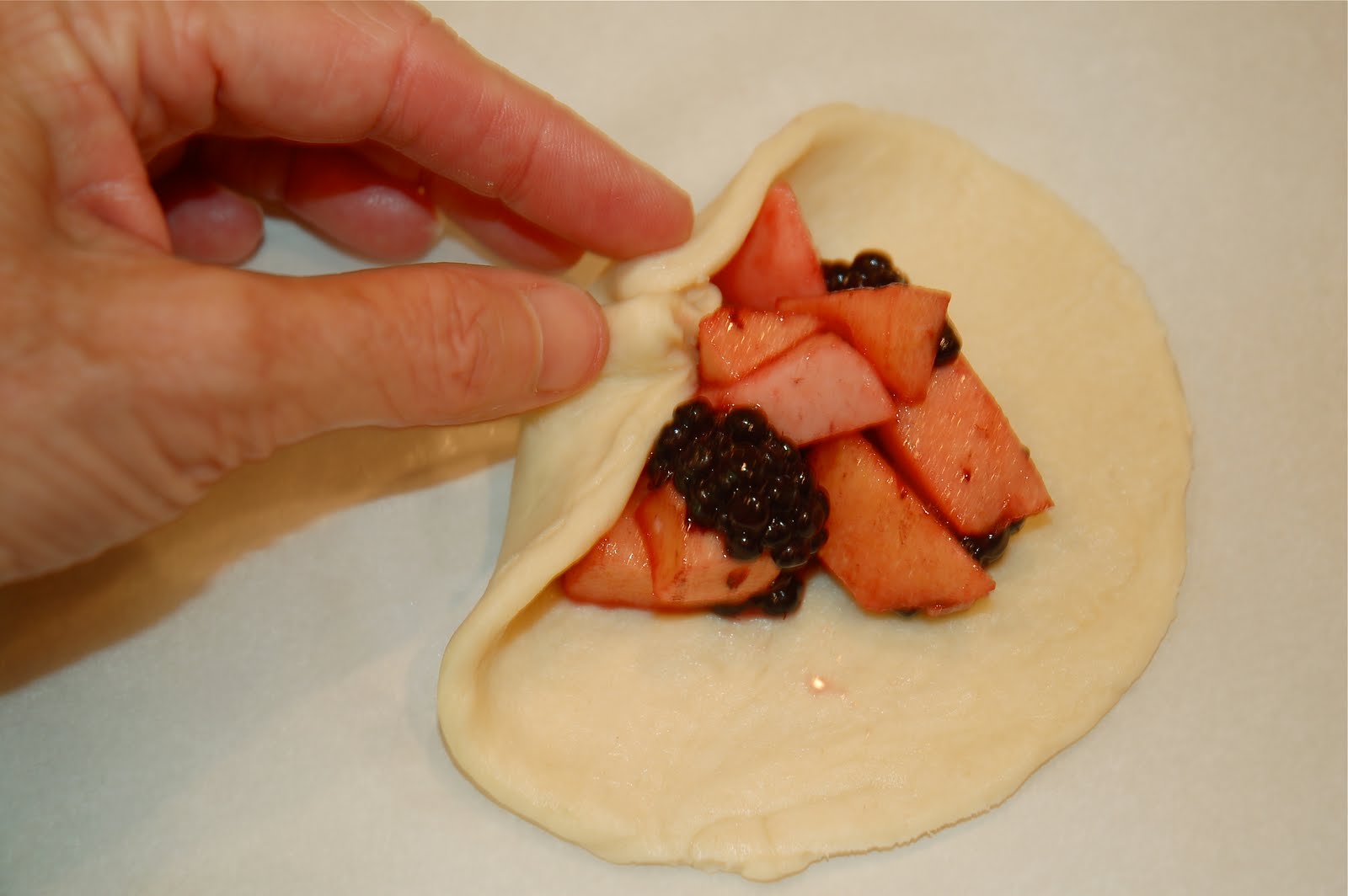
Place about 1 rounded tablespoon of filling just below the center line of the dough. In the one below, the filling is actually placed a little too high, which will make it harder to fold over without some of the filling oozing out the bottom – which will prevent the turnover from sealing properly. What I can do to remedy this, is to roll the top part of the turnover a little thinner and longer. Then, I’ll have a little more dough to pull over and seal the pastry.

apple turnovers 007

In this next picture, the filling is not only a little high, but the dough isn’t square. In this case, I can roll the right side a little thinner and longer, to try and get it square again.

appleturnover

Brush the edges of the bottom part of the dough with a little water.

apple turnovers 008

Fold the dough over the filling, and seal the edges by tamping down on them with the tines of a fork.

apple turnovers 009

Make a few slits in the dough, and then transfer the turnover to the parchment paper. When all of the turnovers are done, you can brush them with milk or egg white wash, to add a little shine, but it’s not really necessary because they’ll be sprinkled with powdered sugar before serving.

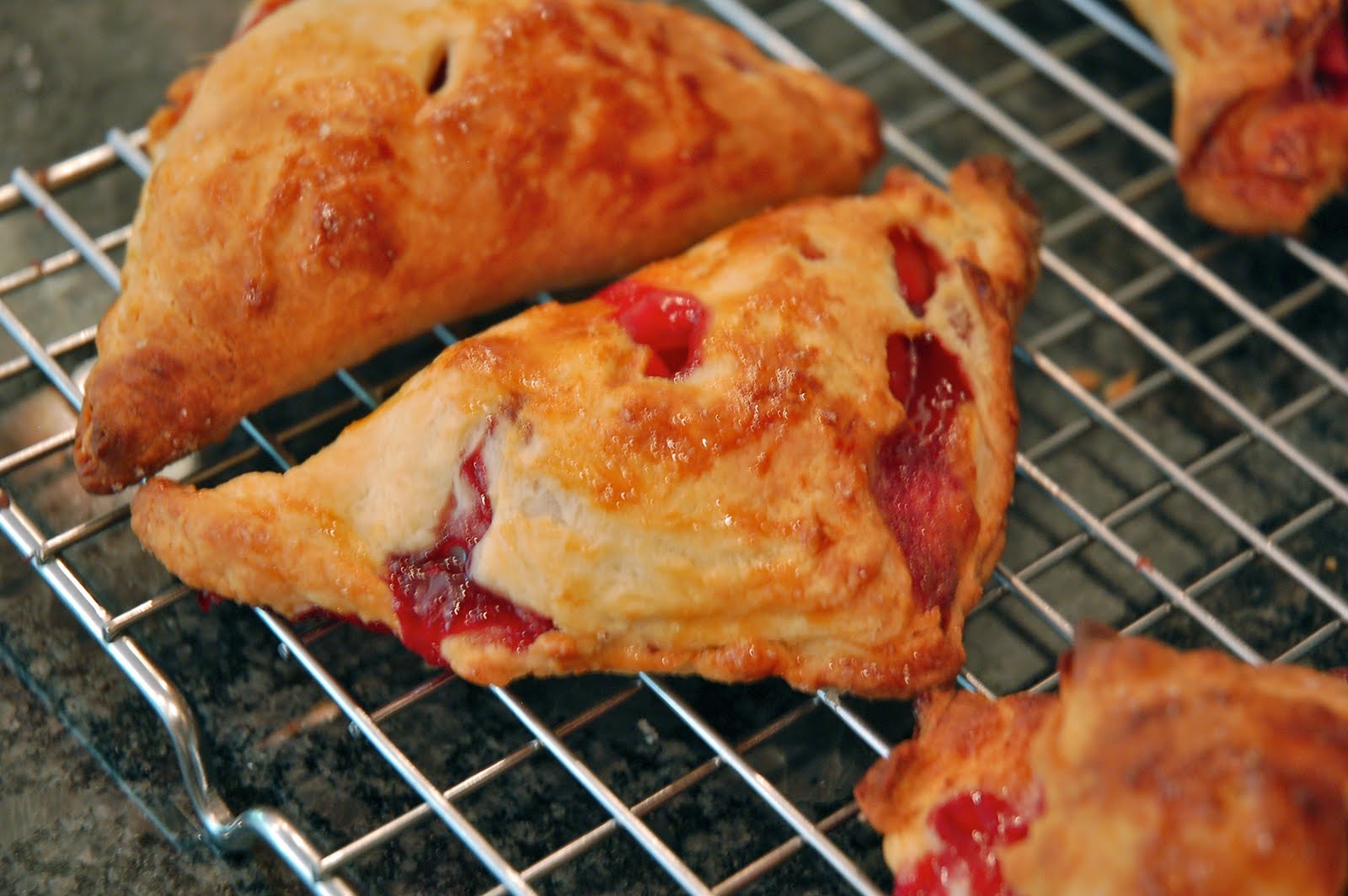
Place the turnovers in the oven and cook them for 20-25 minutes, or until lightly browned, switching the sheets after 10 minutes, so that both sheets get cooked evenly.

Slide the parchment onto cooling racks, let the turnovers cool 5 minutes, and then slide them off of the parchment and onto racks to finish cooling.

apple turnovers 011

Sprinkle the turnovers with powdered sugar before serving. For best taste and texture, eat the turnovers within 6 hours. Unbaked turnovers can be frozen, but they do lose lots of taste and texture.

The turnover pictured under the title is actually a 4-1/2 turnover. that I served as a stand-alone dessert to be served with a fork (and maybe some ice cream!).

Wednesday, November 4, 2009

Rugelach

Because this is one of my favorite cookies (pastry, really), I have a version of it in every book I create. Rugelach are flaky cream cheese pastries filled with cinnamon, sugar, nuts, preserves and sometimes chocolate. Homemade ones are usually crescent-shaped, but it’s easier to shape them into logs. Unlike commercial Rugelach, these are never dry. My trick to making moist cookies is to use the chunks of apricot that most recipes say to strain out. In addition I've added powdered sugar to the pastry dough for the perfect touch of sweetness.

Makes 36-42 cookies

Dough
2-1/4 cups (292 grams) all-purpose flour, fluffed, scooped and leveled into measuring cups
3 tablespoons powdered sugar
Pinch salt

2 sticks (8 ounces) unsalted butter, cold
1/2 pound cream cheese, cold

Filling
2 cups pecan pieces, divided
2/3 cup sugar
1-1/2 teaspoons cinnamon

1-1/2 jars (12-ounce) apricot preserves, room temperature

3/4 cup raisins

1/2 cup unsalted butter, melted together with 1 teaspoon oil

For the dough, place the flour, powdered sugar and salt in a food processor bowl and pulse to mix the ingredients together. Cut the butter into 1/4-inch chunks, add to the processor and pulse on and off, until the mixture looks like coarse meal, about ten, 3-second pulses.

This is not pulsed enough

clip_image002

This is perfect

clip_image004

Add the cream cheese, by tablespoonful to the processor.

Pulse-process until the dough just starts to come together, about seven, 3-second pulses.

clip_image006

Turn the dough out onto a board and press it together.

clip_image008

Shape the dough into a disc, wrap in plastic wrap and refrigerate for at least four hours.

clip_image010

Preheat the oven to 375 degrees F. with a shelf in the middle of the oven. Line insulated cookie sheets with parchment paper. (Using an insulated cookie sheet, will keep the outside from getting overdone before the inside dough is cooked through. In addition, the insulated sheets keep the apricot jam from browning too fast. If you don't have these, nest two cookie sheets together.)

For the filling, combine 1-1/2 cup pecans, sugar and cinnamon in a processor bowl. Pulse-process until the nuts are coarsely chopped. Remove 2/3 of the filling and set it aside. Pulse-process the remaining mixture until the nuts are finely ground. This will be the topping.

Organize a work surface so that you have a rolling space, filling space, topping space, and cutting space.

rugelach 002

Here I have the rolling space on the far end, two waxed paper sheets for filling and topping, cutting space at the near end, and the parchment lined cookie sheet to the right.

For logs:
Roll 1/4 of the dough (7 ounces) into a rectangle 1/16-inch thick x 5-1/2-6 inches wide x 10-inches long, flipping the dough and flouring the work surface as you roll. It should be about 1/16th-inch thick. Cut the dough so that all of the edges are square ( reserve scraps). Move this piece of dough onto waxed paper.

clip_image016

Spoon on about 3 tablespoons of apricot preserves, spreading it thinly to within 1/4 inch of the top edge. Cut any large chunks of apricot into smaller pieces and distribute them evenly over the dough.

Sprinkle 2 - 3 heaping tablespoons of pecan filling (coarsely chopped mixture) over the preserves and press it down into the preserves. Place some raisins in a line on the long edge of the dough. Sprinkle another tablespoon of raisins evenly over the dough and press these down into the preserves, as well.

clip_image018

Roll the dough up from the edge with the raisins towards the clean edge. Brush the clean edge with some of the melted butter/oil mixture and then finish rolling. Press lightly on the roll so that the bottom edge will seal well.

clip_image020

Transfer the roll to another piece of waxed paper. Brush it with some of the melted butter mixture and sprinkle liberally with the topping so that the whole roll, except the bottom, is coated. Cut the log into pieces slightly larger than 1 inch.

clip_image022

Set them on the cookie sheet at least 1-inch apart, seam- side down, with the spiral perpendicular to the cookie sheet .

clip_image024

Bake 25 - 30 minutes
or until nicely browned. Slide the parchment paper onto a cooling rack. Move each cookie out of the pool of preserves that has leaked from the cookie, and then allow the cookies to cool (this sticky stuff will cling to each cookie and may not taste good if it is burned). While one sheet of cookies is baking, prepare another batch of cookies. When re-rolling scraps of dough, roll it thinner, as it tends to puff up more. They also tend to fall over more, so extra care needs to be taken to make sure that they are level.

clip_image026

*If you don't have enough filling (because you've not divided the filling/topping quite right) finely chop the extra 1/2 cup of pecans and mix in some of the extra topping.

Crescents:
I'm not that crazy about crescents because they don't have as much filling in them and they're more time consuming to make. However, if you like them that way, here's how to do it:

clip_image028

Cut the dough into thirds. Roll the dough,from the center outward, into a circle, approximately 12-inches round and about 1/16-inch thick. Lift and flour the dough often. Use a template to cut the dough into a 12-inch round circle. Once the circle has been cut, you can no longer lift the dough up, as the shape will change.

Spread preserves over the dough, cutting up any large chunks. Sprinkle on some filling, using your hand as a barrier to keep the filling in the circle.

clip_image030

Cut the dough into 16 equal wedges, wiping off the blade with a damp cloth between cuts. Place 2 or 3 raisins at the base of each triangle and then scatter the remaining raisins over the dough. Roll the cookies up, from the wide end of each triangle to the tip. Bend the cookies, slightly, to create crescents.

clip_image032clip_image034

Transfer the crescents to waxed paper. Brush with some of the melted butter mixture and sprinkle liberally with the topping. Bake as above but for 2-3 minutes less.

CHOCOLATE RUGELACH

Use the same dough and the same technique as for regular Rugelach. Use this filling and topping instead of the above ones:

3/8 pound semisweet chocolate, chopped up into medium-size pieces
2 cups pecans, divided
3/4 cup sugar
1/2 teaspoon cinnamon

For the topping: Pulse-process 3/4 cup of nuts with half of the sugar and 1/4 teaspoon of cinnamon until the nuts are finely ground. Transfer to a bowl.

For the filling: Place the chocolate, remaining sugar and the remaining cinnamon into the processor and process it until finely ground (wear earplugs – this is very noisy!). Add anther 3/4 cup of and pulse-process a few times just to coarsely chop the nuts.

Assemble the Rugelach, as in the above recipe with these changes:

Use the apricot jam, the chocolate filling, and just one row of raisins to help in rolling up the Rugelach. Roll, brush and sprinkle with the topping. Cut and bake as for regular Rugelach. (The extra 1/2 cup of pecans is in case you need more topping).

The cookies may be stored in a covered container for several days. They may also be frozen in a covered container, with waxed paper between layers. This way you'll be able to defrost each cookie individually. They’ll keep frozen for 3 months. Defrost at room temperature, in a covered container for several hours or overnight.

Sunday, October 11, 2009

Grape Jam

grape jam 064

First, let me say that you have never tasted anything like jam made from the following recipe. It’s not even remotely related to the jam you get in the supermarket, but an intense blast of grape that takes your breath away. Making grape jam is a labor of love - and I do mean labor. If you aren’t serious about cooking and food, you don’t want to even contemplate this recipe. Every year I vow that it will be the last year I make it, but every year as we finish our stash of jam, I once again bring out all of my equipment and settle down for several days of jam making.

Nowadays, in the United States, you can get practically any fruit or vegetable at any time of the year, even if the quality might suffer a little. But if you live on the East Coast, Concord grapes, the kind needed to make grape jam, are only available September through October. For the best jam, it’s best to wait until early October when all of the grapes you get will be dark purple, sweet and plump.

Why is my jam so different from commercial jam? I believe it’s because I pop the pulp out of the skins and cook the pulp, but leave the skins uncooked. These I puree (almost) and then sieve them together with the pulp. I use much less sugar than commercial jam so that the grape flavor can shine through. But make no mistake, this is NOT low-sugar jam – only lower than the commercial variety. Because it’s got less sugar than normal, I do need to use low-sugar pectin.

Penny’s Incredible Grape Jam
Makes 8 wide-mouth 12-ounce jars

7 dry quarts of concord grapes
56-58 ounces sugar (8 to 8-1/3 cups)
3/4 cup water
63-66 grams (more than 1 box) Sure-Jell™ – No Sugar Needed Pectin (in the pink box)
dash of cooking oil

To make this quantity of jam, you are going to need a large canning pot in which to sterilize the jars and seal the jars. And you’ll also need a very large stockpot in which to cook the jam. If you decide to make a smaller quantity, you will need a pot that is 3 times larger than the quantity of jam you are making, as it bubbles up quite a bit as it cooks.

grapejam

I also have some other canning supplies that are useful: special tongs with which to hold the jars, and a funnel that is especially made for jam making. I use a mesh lingerie bag to hold the lids and tops. A food mill is also essential.

To start, put the jars (without the lids and tops), into the canner and fill the whole thing so that the jars are covered by about 1-1/2-2-inches of water. Put the lids and tops in the mesh bag and put it in the canner ( tops can never be re-used, but the lids and jars can be used year to year, as long as the lids are not rusty) . Cover, and bring the pot to boiling. Turn down the heat and keep it at a simmer.

grape jam 022

To make the jam, place the grapes in a colander and wash them well.

grape jam 025

Over the cooking pot, squeeze each grape, forcing the pulp to pop out into the pot. Place the skins in a large processor bowl.

grape jam 028


grape jam 029

I usually process half of the skins at a time, for about 1 minute. They will get very liquidy.

grape jam 032

Pour the contents of the processor into the food mill, which has been placed over a super-size measuring cup. Press the contents through the mill until only the dryish skins remain. Repeat with the remaining skins

grape jam 033


grape jam 034

Add the water to the pulp and set it on the stove. Boil the pulp for 5 minutes. Pour the pulp and liquid on top of the skin residue in the food mill, and press everything through , using a back and forth motion of the mill, so that you aren’t grinding up the seeds, but are getting the pulp to go through.

grape jam 035


grape jam 036

Discard the seeds and remaining residue. You should have approximately 9 cups of grape juice. Remove any extra or add a little water if needed so that you have exactly 9 cups of juice. Make sure that the cooking pot has no seeds in it. Pour the juice into the cooking pot.

Measure out the sugar (there's a range to allow for personal taste, but also the grapes vary in sweetness). In a small bowl, combine 2/3 cup of the sugar with the pectin (you have a range here too - also depending on how sweet the grapes are).

Gradually stir this into the grape juice. Add a dash of oil, so that the jam doesn’t get too foamy when it starts to boil.

Set the pot on the stove and bring it to a full-rolling boil – that is, a boil that can not be stirred down, stirring continuously ( the mixture will be a muddy, maroon color).

grape jam 040

Dump in the sugar, all at once. Stirring continuously, cook until the sugar is completely melted, and then bring the mixture to a full rolling boil again. Boil hard for 1 minute, stirring constantly. At this point the mixture will triple in volume, bubbling furiously, and will change to a dark purple color (although the picture doesn’t show the color clearly).

grape jam 043

When the minute is up, turn off the heat. If using an electric stove, you will need to slide the pot off of the burner, so that it doesn’t continue to cook. Skim off any foam and discard it.

Take three of the jars out of the boiling water, using the special jar holder (so that you don’t get burned), emptying the water back into the pot. Turn the jars upside down onto a towel, and then using oven mitts, turn them right side up. Remove the tops and lids from the boiling water and let drain on the towel, as well.

grape jam 048

Place the funnel in one jar, and ladle in the hot jam, filling the jar as high as it will go without touching the funnel.

grape jam 053

Remove the funnel. If there is any jam on the rim of the jar, wipe it off with a clean, damp cloth.

grape jam 054

Place the top on the jar and then screw on the lid. Repeat with the remaining jars, and then take out three more hot jars and repeat the process.

grape jam 055


grape jam 056

Tighten the lids, and using the jar holder, place the jars back in the boiling water. Cover the pot, and simmer the jars for 5 minutes.

grape jam 058

Remove the jars from the simmering water, and set them aside to cool. As they cool, you should here the lids pop down. To make sure that each jar is well sealed, press on the top of the lid. If there is any movement, the jar is not sealed, and should be placed in the refrigerator. The remaining jars can be put in the pantry for 12-18 months. To use, remove the screw lid, and use a beer bottle opener to pry up the top. Store in the refrigerator once opened.

grape jam 061

You can see in the photo that the jam on the back muffin is redder and thicker and the jam on the front half is more grape-looking and runnier. Both were made with the exact same recipe. Logically you would think (or I did) that the darker one would be sweeter. But in fact the darker one was more tart and runnier. Cooking might be science, but sometimes you don’t know what the parameters are until you are into it! At this moment I am recooking the runny jam with another half cup of sugar and 4 tablespoons of pectin/water mixture (ratio is on the box of pectin). Always an adventure!

Saturday, October 10, 2009

The Best Apple Pie


This past weekend we went to Boston to visit our daughter. One of the trips she had planned was to a nearby apple orchard for an afternoon of apple picking. The farm had many different varieties of apples, and we came away with more than a bushel of Cortlands, Macintosh, Empire and Macoun apples. With so many apples the logical thing to make was apple pie, so that’s what we did the next day. Expecting great things, we were disappointed when we tasted the pie, that evening. Why wasn’t this the best apple pie?

Let’s start with the apples. For an 8-inch pie, I usually use 10 cups of apples consisting of about 5 Granny Smith apples, 1 golden delicious and 2 Macintosh apples. It’s a blend that I’ve come up with over the years that satisfies my requirement for texture, moisture and taste. Because the pie we made in Boston wasn’t sweet enough or juicy enough, I decided to go back to the kitchen and write down what happens to each apple when it is cooked. For my experiment I used 2 ounces of each apple (about 1/2 apple, but I did it by weighing for accuracy), 1 tablespoon of brown sugar and 1/6th tablespoon of butter. Each was covered with foil and baked in a 400 degree F. oven.

applepie_01

applepie_03 When I uncovered the apples there was a striking difference between the amount of liquid in each cup. The Macouns were gushers, giving off 6 teaspoons of juice, the Macintosh gave off 4 teaspoons (but the Macs I bought in the supermarket only gave off 1), the Empires 3 teaspoons (same for the store-bought Empires) and the Cortland only 1 teaspoon of juice. Since the pie we made in Boston was mostly Cortlands, I now knew why our pie was not as juicy as we would have liked. I also tested the apples that I normally use: Granny Smiths and Golden Delicious. The Granny Smiths gave off 3 teaspoons while the Goldens gave off 5. This would account for my pies almost always flooding into the plate when the first piece is removed.

applepie_0

applepie_1

So to start making YOUR perfect pie, you would decide whether you like your pie very moist, medium-moist or on the dryer side, and then you could choose the appropriate apples. If you wanted a very sweet pie, it wouldn’t be a good idea to use only Golden Delicious, though, because you’d have so much liquid, you’d never get it thick enough. Instead, you could add a little more sugar to the tarter apples and mix in only one or two of the very juicy, sweet apples. Because we wanted to use only the apples we picked (tarter , drier varieties) we should have added a little extra sugar, and could have added some fresh apple cider to make up for the lack of moisture. There’s also a question of tenderness with the filling and you’d want to combine apples that get pretty soft when cooked with those that are firmer. Some apples take forever to cook, and might not be a good choice for a pie in which the crust will be done in about 50-60 minutes. Romes and Macs tend to get very mushy – which I think gives a nice taste and texture when used in combination with firmer apples. Empires, Cortlands, Macouns, Goldens, etc. are medium-firm and Fujis and Galas tend to take longer than 60 minutes to get soft, unless sliced very thinly. Lastly, the amount and kind of thickener needs to be chosen. My mother always used tapioca to thicken her pies. But tapioca (cracked or pearls) leaves little gelatinous globules in the pie that I’m not fond of. Flour is really not a favorite of mine either. If it doesn’t get mixed well, it can be very unpleasant, and if the apples don’t heat up enough or for a long enough time, the flour will taste gritty or pasty. I usually use cornstarch, even though it doesn’t do that well with acidy foods like apple pie – another reason that my usual pie is on the runny side (maybe I should mix in some Cortlands next time). For a pie made with mostly Cortlands, I would cut way down on the amount of cornstarch used – maybe half as much. Yesterday, I tried tapioca starch, which actually gave me the absolute perfect thickness! I bought it in Earthfare, my local organic market. It looks exactly like cornstarch, and the box directions said to use the same quantity as cornstarch. I used the recipe you’ll find below, and have never been as happy with the results.


But back to Boston… Could more have gone wrong with my pie in Boston? You bet. The crust was really just mediocre. I knew from the get-go that I probably hadn’t used enough water in the dough. I was worried about the crust being tough – a problem I had had the last time I made flaky crust- and water is usually the culprit when crust gets tough. I thought it might be a little dry (it was), but was surprised that the crust was so tender that it barely had any texture in the mouth. As a bottom crust it was fine, but the top crust really didn’t work. So, of course, my challenge when I got home was to figure out exactly how to tell when you’ve added enough water. Here’s the answer: The dough should feel supple, but not sticky, and it should hold together. You should be able to pick up the dough ball and hold it above the counter without it falling apart.

apple pie 019

When you roll it, you should be able to fold it without it cracking.

apple pie 021

If any of these problems arise, add a little more ice water to the dough. If the dough is too sticky, it could be because it’s not cold enough, or it might need more flour. If it needs to be toughened a little, you can also fold it and then re-roll it. This works especially well for the top, because it makes it flakier. And so, here is MY Perfect Apple Pie


apple pie 015

Serves 6 - 8

MAKE DOUGH 1 DAY AHEAD

Flaky Pie Crust
2-1/2 cups (325 grams) unbleached all- purpose flour, fluffed, scooped and leveled into measuring cups

1 teaspoon salt
1 tablespoon sugar
10 tablespoons (5 ounces) shortening, frozen and cut into 1/2-inch cubes

5 tablespoons (2.5 ounces) unsalted butter, cold and cut into 1/4-inch slices

1/4 cup (or more) ice water, divided

Filling
3-5 medium Granny Smith apples
1 medium golden Delicious apple
2 medium McIntosh apples
1 lemon or 1 tablespoon of Fruitfresh mixed 2 quarts with water

3/4- 1 cup packed light brown sugar
1 teaspoon cinnamon
1/4 cup tapioca starch (or cornstarch)

1 tablespoon unsalted butter, cut into 1/4-inch cubes

Glaze
1 tablespoon milk
1 teaspoon sugar

Place the flour, salt and sugar in a food processor bowl. Pulse-process to mix everything together. Place the shortening and butter on top of the dry ingredients. Pulse-process until the fats are cut into pea-size bits, about 5, three-second bursts. Transfer the mixture to a bowl. Sprinkle on 3 tablespoons ice water. Mix with a fork and then, using your hands, press the mixture into a solid mass. If necessary, add more water to bring the dough together. The dough should feel supple, but not sticky, and it should hold together. You should be able to pick up the dough ball and hold it above the counter without it falling apart. Divide the dough in half. Wrap each piece in plastic wrap and refrigerate several hours or overnight.

Preheat the oven to 425 degrees F. with a rack in the middle of the oven. Grease and flour an 8-inch glass pie plate . (Flouring the plate is controversial, as there is a risk that the dough could shrink off of the pie plate rim. However, it’s so much easier to get the slices out of the pan when the plate is floured, that I do it anyway. )

For the filling, peel, core and cut the apples into 1/4-inch slices, using as many as necessary to have 10 cups of apples. Squeeze the lemon into a large bowl of water, or use the Fruitfresh. Place the apples into the bowl of water, drain, and then return the apples to the bowl along with the brown sugar, cinnamon and tapioca starch.


Transfer the dough to the pie plate using one of these techniques: Flip the dough over the rolling pin. Pick the whole dough piece off of the plastic and lay it into the pan.


OR
Flour the dough, fold it in half or quarters, and then transfer it to the pan and unfold it .


apple pie 021

There should be several inches of overhang. Trim the dough to 1/2-inch beyond the rim ( I use my thumbnail as a guide).

pie crust1

Transfer the filling to the crust-lined pie plate, mounding it high in the pan. Dot with the butter.

apple pie 023

Brush the rim of the crust with water so that the top crust will adhere well.

apple pie 024

Roll out the remaining dough, making it larger than the bottom crust, so that it will fit over the mounded apples.

apple pie 025

Trim the top crust so it is the same size as the bottom crust. Squeeze the two edges together and then roll the edge up to make a nice border on the pan rim.

apple pie 027

Here you can see that I’ve rolled the right edge of the pie crust, but not the left side, yet. I also experimented with cutting out a diamond shape in the middle of the crust as a steam vent. It also gives me a good place to stick a knife into the apples to see if they are cooked. But I think I liked the round vent hole better (see opening photo). It was easier to get it in the center and it didn’t tend to rip the way the diamond did.

Flute the edge using one of the techniques from this post on Pies and Tarts: http://www.blogger.com/post-edit.g?

apple pie 028

Make 4 or 5 slits in the pie with a sharp knife. Mix the sugar with the milk and brush this over the crust ( or brush with milk and sprinkle with sugar – your choice).

Place the pie on a baking sheet. Bake the pie for 25 minutes. Reduce the temperature to 375 degrees F. and bake for another 30 - 40 minutes more until both the top and bottom crusts are golden. Shield the pie rim with aluminum foil if it is getting too brown. To make a simple shield, take 3 pieces of aluminum foil slightly large than the pie. Crimp the edges up to make it less square and to hold the pieces together. Cut a cross in the middle of the foil and bend back the foil, from the center outward, to reveal the pie below. Set the shield on top of the pie – it should leave the center open to brown but will shield the rim crust, which always cooks faster.

pastry tools 001

Cool at least 30 minutes before eating.

For best results, the pie should not be made more than 8 hours in advance (leave uncovered at room temperature). Rewarm it at 350 degrees F. for 15 minutes. Leftover pie should be covered with plastic wrap and refrigerated. Heat at 350 degrees F. to re-crisp the top crust.

Friday, October 9, 2009

Making the Best Apple Pie


I'm almost done with this post, but need a few more photos which will be coming tomorrow (needless to say I am making this again). Check back tomorrow for my saga of making the best apple pie, and a recipe.