Monday, May 31, 2010

Bread Pudding Variations

That's Caramel Bread Pudding you're looking at in this photo.  But I'm also going to give you a variation for a lower fat version.  For the complete recipe for bread pudding, you'll need to see the prior post on bread pudding.

How to make the caramel:
1 cup sugar
1/3 cup water
1/4 teaspoon white vinegar

1/4 cup additional water

Place the sugar, 1/3 cup water and the vinegar in a stainless steel pot (if you use a dark or nonstick pot, you  won't be able to tell when the caramel is the right color).  Heat the mixture on medium to medium-low heat, stirring constantly until the sugar dissolves.  Brush down any sugar crystals on the sides of the pot with a brush dipped in water.  Increase the temperature to medium-high to bring the mixture to a boil.
(You don't need to use a pot this large - but it's the only stainless steel one that I own).
Once the mixture starts to boil, DO NOT STIR!  Swirl the pot, occasionally, so that no spot cooks before another, and cook until the mixture turns golden brown.

Tip the pan away from you, so you don't get burned, and pour in the remaining 1/4 cup of water.  It will bubble up and steam furiously.  Stir until the caramel is smooth.
Pour the mixture into the baking pan ( I prefer not to use glass, because I am always wary about pouring such hot liquid into glass, even if it is Pyrex).

Let the caramel cool briefly and then set it in the refrigerator or freezer until it's hard (15 mnutes if frozen and up to 1 hour if refrigerated).

Make the bread pudding as in the last post, or using the lowfat directions below.  You can eat the pudding 1 hour after it is made and the caramel will be syrupy and the pudding soft, or you can refrigerate it for at least 6 hours.  At that point the caramel will be a bit gooey and the pudding firmer (as in the photo above)  After 2 days in the refrigerator, you'll have both some gooey caramel, some melted caramel sauce and a firm pudding  - my favorite.  You can heat it slightly or serve it cold. 


Lower fat Bread Pudding with Lowfat Custard Sauce
9 ounces challah, eggy white bread or lowfat Italian bread (I've used Arnold's)
1/3 cup raisins
3 large eggs
2 large egg whites
1/2 cup sugar
1 teaspoon vanilla extract
1 teaspoon cinnamon
2-1/4 cups 2% milk (using skim or 1% results in a very soft-set pudding)

Make the pudding according to the directions in the post on Raisin Bread Pudding
Lowfat Custard Sauce
2 large eggs, at room temperature
1/4 powdered cup sugar
1 teaspoon cornstarch

2 cups 1% lowfat milk
1/4 cup granulated sugar
1/2 large vanilla bean, split in half, lengthwise
1 tablespoon rum or other liqueur, optional

In a medium bowl, whisk together the eggs, powdered sugar and cornstarch.
Place the milk, granulated sugar, vanilla bean and rum in a medium pot.  Bring the mixture to a simmer.
Little by little, whisk the hot milk mixture into the egg mixture, adding more and more as the eggs get warmed. 

Pour the mixture back into the pot.  Heat on medium, stirring contantly, until the mixture comes to a simmer.  Lower the heat and simmer for 1 minute.  Pour the mixture into a container.  Scrape the vanilla seeds into the custard and discard the pod.  Let it cool briefly, and then cover and store in the refrigerator for up to a week. 


Wednesday, May 19, 2010

Raisin Bread Pudding with Custard Sauce


In my last post , on challah, I mentioned that it makes wonderful bread pudding, so I thought I would work on a few recipes to give you. We've been eating bread pudding for a few days now, and I'm ready to share the standard recipe with you, and will continue to work on  caramel and chocolate versions to share in a week or two (and probably a lower fat version).  We like our bread pudding firm, so I don't bake it in a waterbath, and we let it rest in the refrigerator for a day, and then reheat it in the microwave.   But if you like it soft, by all means bake it in a waterbath and/or eat it when it comes out of the oven and has cooled for 30-60 mnutes.  This is just one of the great things about baking it yourself - you can tailor it so that it is perfect for you!

For the pudding:
9 ounces challah or eggy white bread , cut into 1/4- inch x 1-inch squares (about 6  lightly packed cups)
1/3 cup raisins
5 large eggs
1/2 cup sugar
1 teaspoon vanilla extract
1 teaspoon cinnamon
2 -1/4 cups whole milk, more if needed

Preheat the oven to 325 degrees F., with a rack in the lower third of the oven.  Leave the sliced bread out, on cookie sheets for 8 hours, or place the bread on a cookie sheet, and lightly toast it in the oven for 5 minutes (it should not brown, but should become somewhat dry). Remove, and let cool.
Place the bread squares in a 2-quart baking dish (I like an 8x8-inch square, baking pan). Sprinkle the raisins over the bread (the bread should fill the pan, more than pictured below)
.

In a medium bowl, lightly whisk together the eggs, sugar, vanilla, cinnamon and milk. Pour  the milk mixture over the bread. Press down on the bread with the back of a spoon. Submerge any raisins that are at the top, as they will over-bake if exposed. Let the bread soak in the milk for 15 minutes, pressing occasionally with the back of the spoon. All of the bread should be moistened and the bread should not soak up all of the milk mixture.  If necessary, add more milk (this will vary depending on the type of bread used, and how soft you want the finished pudding to be).


Bake the pudding for 55-65 minutes, or until puffed and set. The pudding will have risen high out of  the pan, but will settle back down as it cools.


Remove it to a rack and let cool for at least 1 hour. If you prefer a firmer pudding, refrigerate it until near serving time, and then microwave the pudding just until barely warm. If a softer pudding is desired, it can be served after it has baked, and cooled to warm. Bread pudding can be made 2 days ahead. Keep refrigerated, and before serving, microwave until warmed through.

Custard Sauce
4 large egg yolks
1/4 cup powdered sugar
1/4 teaspoon cornstarch

1 cup half & half, or 1/2 cup half & half and 1/2 cup whole milk
1/2 vanilla bean, split in half lengthwise
1 tablespoon rum or other liqueur, optional

Most custard sauces do not have powdered sugar and cornstarch in them. When made without any thickener, the custard can over heat very quickly and then you have little bits of scrambled egg in your custard - not very appealing! Adding this tiny bit of starch gives you a  bit of wiggle room, so that you'll have more success in making the sauce.  Fresh vanilla beans are soft and can be split with a knife or scissors.  If yours are hard you can add it to the hot liquid and let it soften before cutting it.  Some people reuse the pods, but I don't think that's such a great idea unless the vanilla pod is being soaked in just plain water.


In a medium-sized bowl, whisk together the eggs, powdered sugar and constarch.  Set aside.

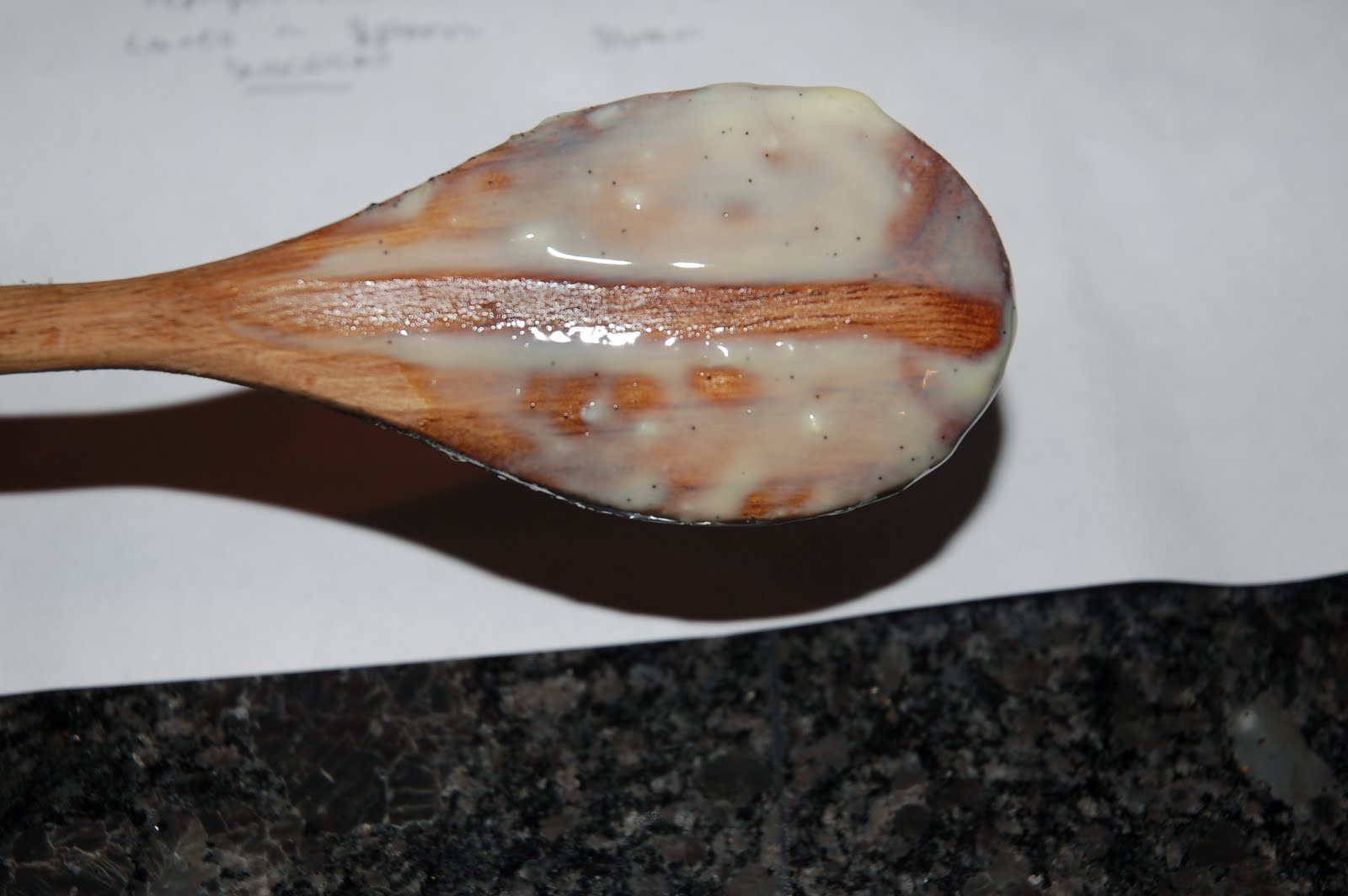
Place the half & half and vanilla bean in a medium pot. Add the rum now, if you want to burn off some of the alchol. Alternatively, it can be added when the cream mixture is removed from the heat. Place the cream mixture over medium heat, and bring it to a simmer. Drop by drop, whisk some of the cream mixture into the egg yolk mixture. As the eggs warm up, the cream mixture can be added faster and faster. Transfer everything back into the pot. Cook this on medium heat, until bubbles start appearing around the edges of the pot, and the mixture will just coat the back of a wooden spoon.


Strain the custard into a storage container. Scrape the vanilla seeds from the pod into the custard, and then add the pod back into the custard. Let it cool briefly and then cover and refrigerate until cold. The sauce can be served cold or warm.  To rewarm the custard, place it in the top of a double boiler, and heat it over simmering water. It can also be reheated in the microwave on low power.

If you're eating the bread pudding shortly after it is made, it can be scooped out like you see in the opening photo.  But if you let it rest overnight, ou can cut it into neat squares.  The sauce is delicious warm or cold.  I prefer to have my bread pudding just barely warm and my sauce cold, while my husband likes his bread pudding hotter and his sauce warm .

Sunday, May 16, 2010

Challah - Jewish Egg Bread

This braided Jewish sweet bread makes wonderful bread pudding and great French toast. It can be made in a bread machine or with a mixer but is best baked in the oven, so it can develop its distinguishing crust.  Braiding contributes to both taste and texture and is an essential characteristic of Challah. If I'm making a challah specifically for bread pudding or French toast, I often do a simple 3-strand braid rather than the traditional 6-strand braid. The dough can also be shaped into a spiral-round, as you seein the picture above, and this is a favorite shape for Rosh Hashanah and symbolizes the circle of life.  The dough can also be made into nice dinner rolls.  Challah is a very personal thing - some like it very eggy, some very sweet, some like it cakey and some more like bread.  My recipe is of the "bready" variety.  If you like it cakey, you can add more oil  and eggs.  Just adjust the amount of water correspondingly.  If you like it more tender, you can use milk instead of water. 

Makes 1 or 2 loaves or 20-30 rolls

For Mixer
1-1/3 cups warm water
1/4 cup oil
1/4-1/3 cup honey
2 large eggs, room temperature (place them in their shells into warm water for 2 minutes to bring them to room temperature

5-1/2 cups (608 grams and 135 grams, divided) bread flour
1 tablespoon rapid-rise, quick-rising or instant yeast ( I buy mine in bulk from King Arthur Flour)
1-1/2 teaspoons salt

1 large egg mixed with 1 teaspoon water, for glazing
Poppy seeds for sprinkling

To make the bread in a mixer:
Place the water, oil, honey, and eggs in the mixer bowl and beat to blend everything together.

Measuring the oil before the honey will allow the honey to flow out of the cup, instead of sticking.


Add all but 1 cup of flour (608 grams), the yeast and salt to the egg mixture. Beat, on low speed, with a flat beater attachment, until the dough starts to clump together.


Switch to the dough hook and knead on medium-low speed, adding the remaining flour, ¼ cup at the beginning and then 1 tablespoon at a time, as the dough progresses.   Add only enough flour to make the dough tacky, but not overly sticky.  It's okay if it sticks to the bottom of the bowl, but should not be very sticky when you pinch the dough. Continue machine kneading for 8 - 12 minutes. The dough should be moist and supple.  The final kneading will be done by hand. 


 When you take it out of the bowl, it will still be very rough looking.  Knead it,  adding a very little bit of flour if necessary to keep it from sticking to the board. 


Here's how to knead:


Press down on the dough with the heels of your hands (use both hands).
Then roll the dough towards you.


so that it folds up on itself.  Press again with the heels of your hands.  Roll and press the dough a few times and then turn the dough a quarter turn and repeat the whole process. Continue until the dough forms a smooth and elastic ball.


 Pinch out a small piece of the dough, and continue pinching and flattening. If the dough is done, it should be able to be pressed and pulled until you can just see your fingers through the dough.


Oil a bowl, add the dough, and turn it over in the bowl so that all sides of the dough are oiled. Cover with plastic wrap and leave at room temperature to rise until doubled in volume (about 1 hour).

To test if the dough has doubled, flour a finger and gently poke the dough. If the indentation remains, the dough has risen sufficiently.

In the picture on the left, the dough wasn't risen enough, and the  hole started to fill back up.
The picture on the right shows the dough risen enough.


Turn the dough out onto a work surface. The recipe will make either 1 or 2, depending on how large you like them. Place the half that you aren't working with back in the bowl and cover it until ready to use.

Shaping
For a 6-strand braid, divide the remaining dough into 6 equal pieces . If using raisins, flour them lightly and press them into each piece of dough, and then roll the dough up to enclose the raisins.


When rolling each piece into a rope, it's important that the board be unfloured.  Roll each piece into a long skinny rope, about 10 to 12-inches long.  Use the shorter length if you prefer a fatter challah and a longer length if you prefer a thinner, longer challah.


To roll the dough into ropes:

Start in the middle with both hands lightly pressing on the dough.  Roll forward and back moving your hands from the center of the dough towards the edges, until you have the size rope you want.


Once all of the dough has been rolled into ropes, they should be sprinkled liberally with flour, so that they won't stick while you work with them, and so that the braiding will be more delineated in the final bread.

Braid, using this pattern: 2-1-5-6
As follows:

Attach six ropes together. Move strand #2 up past #6


Re-number the stands from left to right.

Move strand #1 between #3 and #4


Re-number the strands.


Move #5 up to the #1 position.


Re-number the strands.


Move #6 between #3 and #4.


Repeat these steps until you reach the end of the braid. Pinch the ends together.


Each  picture below shows how the bread shaping progresses after each  2-1-5-6 pattern.


Transfer the completed braid to a greased and floured cookie sheet, cover with a non-linting towel, and  let rise for about 45 minutes until it has doubled in size. While the dough is rising, preheat the oven to 375 degrees F. with a rack in the middle of the oven.

To see if it has doubled, flour a finger and gently poke the bread.  The indentation should not stay, but should pop back out. 

Mix the egg with 1 teaspoon water to make a glaze. Brush the glaze over the bread and sprinkle with poppy seeds. An easy way to make sure that the seeds are sprinkled evenly, is to hold the seeds in the palm of your hand and turn your palm up with your fingers closed. Shake your hand side to side and the seeds will just come out of the the little opening at the pinky side of your hand.


Set the dough into the middle of the oven and bake 15 minutes. Reduce the temperature to 350 degrees F. (If you like your challah less brown and more golden, cook on the higher temperature for only 5 minutes).  Brush the bread again with the glaze and continue to bake 15 - 20 minutes more, until the bread sounds hollow when tapped on the bottom (the internal temperature should be 190 - 200 degrees F.). Place the bread on a cooling rack. Do not cut the bread until completely cooled.

Alternatively, you can make a “6-strand braid”, by dividing the dough into pieces of unequal size: 2/3 and 1/3. Divide each piece into 3 pieces and braid each piece into a 3-strand braid. Transfer the larger braid to the prepared cookie sheet. Brush the large braid with egg wash and set the smaller braid on top. Cover and let rise for 30-45 minutes until doubled  and then proceed, as above.

To make Rosh Hashanah round loaves: add ¾ cup raisins during the early kneading stage. Roll the dough into a fat rope, about 1-1/4-inches in diameter (make 2 if using the mixer batch). Coil each piece into a loose round, and then proceed, as above.
To make challah rolls:
Divide the dough into 20 pieces, if using the bread machine recipe and about 36-40 if using the mixer method. Roll each piece into a rope, about 6-inches long. Shape the dough as if you were going to tie it in a knot, but instead of pulling it tight, leave one end sticking up through the center. Tuck the other end under the roll. Let the rolls rise until doubled, glaze and sprinkle with seeds and bake for a total of 15-20 minutes, until the rolls sound hollow when tapped on the bottom.


To make the challah in a bread machine, divide the recipe ingredients in half.  Add the wet ingredients ( water, oil, honey and eggs) to the machine bowl.  Add the flour, yeast and salt.  Use the dough cycle. After the dough has doubled (about 1 hour), proceed with the shaping instructions, as above, making either 1 loaf or 15-20 rolls.